Why coming off an antidepressant goes wrong, and how to make it go better.
Most people who stop an antidepressant do it the obvious way: halve the tablet, halve it again, then stop. It looks gradual. To the brain it is anything but, and it is the commonest reason a planned withdrawal turns into a distressing one.
This guide explains why, and what to do instead.
Nothing here is a substitute for your prescriber. Do not change a dose on the strength of a web page — including this one.
The shape of the problem
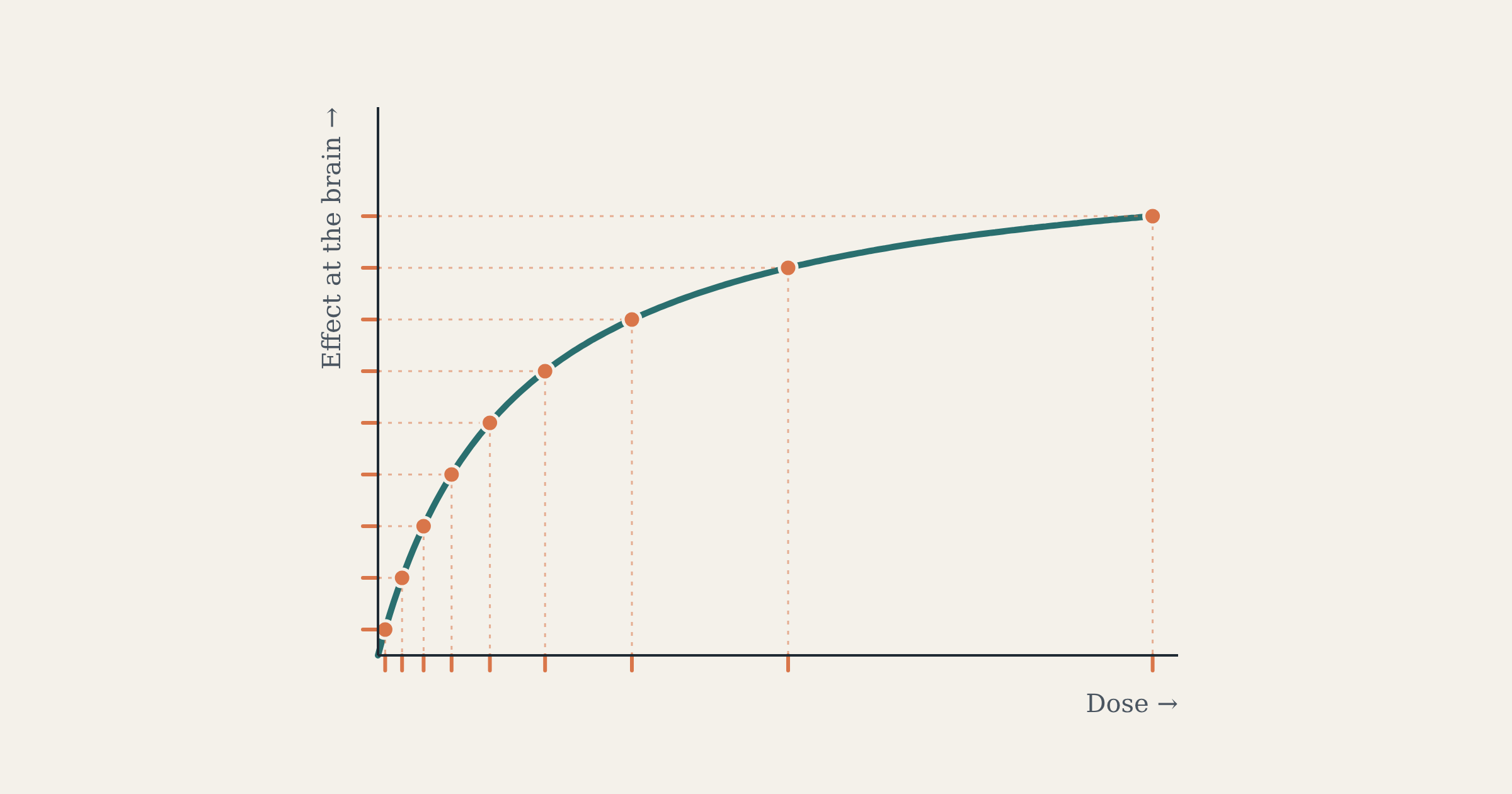
Antidepressants in the SSRI class work mainly by blocking the serotonin transporter (SERT). The relationship between the dose you swallow and the proportion of transporters actually blocked is not a straight line. It is a curve that rises steeply at first and then flattens — the same mass-action relationship that governs most drug–receptor binding (Sørensen, Ruhé and Munkholm, 2022).
Two consequences follow, and between them they explain almost everything about why tapers fail.
At the top of the curve, large dose changes do very little. A standard therapeutic dose already sits close to saturation. Halving it releases a surprisingly small fraction of transporters, which is why the first cut is often easy and gives people false confidence about the rest.
At the bottom of the curve, small dose changes do a great deal. Down in the low-milligram range, every fraction of a milligram is holding a substantial share of transporters. The final step from a small dose to nothing is frequently the largest single change in the entire taper — larger than the first cut, by some margin.
This is the counterintuitive heart of it. The last step is the biggest, not the smallest. People plan for the beginning and are ambushed at the end.
Why linear tapers fail
Equal steps in milligrams produce escalating steps in effect. A schedule like 50 → 25 → 12.5 → 0 looks like four even stages; in terms of what is actually happening at the transporter it is one gentle change followed by three increasingly violent ones, with the worst saved for last.
The fix is to make the steps even in effect rather than in milligrams, which means the milligram drops must get progressively smaller as the dose falls (Horowitz and Taylor, 2019).
The rule
Reduce by a fixed proportion of your current dose — not of your starting dose.
A reduction of roughly 10–25% of the current dose, held for four weeks or more before the next step, is the usual recommendation. Because each reduction is calculated afresh from where you now are, the milligram steps shrink automatically as you descend. That is what makes a taper hyperbolic.
Two practical points that follow from this and surprise people:
- A proper taper has many more steps than you expect. Ten to fifteen is normal. A taper lasting a year is not excessive for someone who has been taking the drug for years.
- It never quite reaches zero by arithmetic. At some point you stop from the lowest dose you can reliably measure. Getting that dose as low as possible first is the whole object of the exercise.
How long?
Longer than most schedules suggest, and scaled to how long you have been taking it. Someone on an antidepressant for six months may manage a relatively brisk reduction. Someone on it for a decade should expect a taper measured in many months to years (Horowitz and Taylor, 2019).
There is no virtue in finishing fast. The only thing that matters is finishing.
Recognising discontinuation symptoms: FINISH mnemonic
Withdrawal symptoms usually appear within two to four days of a reduction, and are easily mistaken for something else. The mnemonic FINISH is the standard aid (Berber, 1998; Gabriel and Sharma, 2017):
- F — Flu-like symptoms. Lethargy, headache, aching, sweating.
- I — Insomnia. Difficulty sleeping, often with vivid or disturbing dreams.
- N — Nausea. Stomach upset, occasionally vomiting or appetite loss.
- I — Imbalance. Dizziness, vertigo, light-headedness, a “spaced out” feeling.
- S — Sensory disturbance. Burning or tingling, and the electric-shock sensations widely known as “brain zaps”.
- H — Hyperarousal. Anxiety, irritability, agitation, internal restlessness.
Telling withdrawal from relapse
This is the question that frightens people most, and it deserves a careful answer rather than a tidy one.
Timing is the most useful signal. Withdrawal tends to appear within days of a reduction. A genuine return of depression usually takes weeks and builds more slowly.
Response to reinstatement helps, but is not a definitive test. If symptoms settle within a few days of going back to the last tolerated dose, that points strongly towards withdrawal. But this is not universal — some people experience a protracted withdrawal that does not resolve quickly, and reinstatement can work less well after a long gap. A response supports the diagnosis; a non-response does not rule it out.
Sensory disturbances are characteristic. Brain zaps and electric-shock sensations are typical of discontinuation and are not a usual feature of depression. Treat them as a strong pointer rather than absolute proof.
If you cannot tell, that is a reason to speak to your prescriber, not to push on and find out.
A worked example: escitalopram
Escitalopram is used here for a practical reason. It is the one SSRI available in Australia as a registered oral liquid — Lexapro oral solution 20 mg/mL, PBS-listed as a Restricted Benefit for major depression and for moderate-to-severe generalised anxiety and social anxiety disorder. A 15 mL bottle costs the standard general patient charge, with repeats.
That matters, because the low end of any taper needs doses no tablet can deliver. At 20 mg/mL, 1 mg is 0.05 mL — measurable with an ordinary 1 mL oral syringe.
Each step below is roughly a 20–25% reduction of the preceding dose. This is an illustration of the shape of a taper, not a prescription. Your prescriber sets the doses and the pace.
| Step | Dose | Volume | Reduction |
|---|---|---|---|
| Baseline | 10 mg | 0.50 mL | — |
| 1 | 8 mg | 0.40 mL | 20% |
| 2 | 6 mg | 0.30 mL | 25% |
| 3 | 5 mg | 0.25 mL | 17% |
| 4 | 4 mg | 0.20 mL | 20% |
| 5 | 3 mg | 0.15 mL | 25% |
| 6 | 2.4 mg | 0.12 mL | 20% |
| 7 | 1.8 mg | 0.09 mL | 25% |
| 8 | 1.4 mg | 0.07 mL | 22% |
| 9 | 1.0 mg | 0.05 mL | 29% |
| 10 | 0.8 mg | 0.04 mL | 20% |
| 11 | 0.6 mg | 0.03 mL | 25% |
| 12 | 0.4 mg | 0.02 mL | 33% |
| 13 | 0.2 mg | 0.01 mL | 50% |
| 14 | Stop | — | — |
Four weeks a step makes this a year. That is normal, and the schedule is meant to be stretched rather than compressed — if a step is uncomfortable, hold at it longer before the next one.
Notice what the table does that a linear taper does not: by the end, the steps are hundredths of a millilitre. That is the point.
If you are on something else
Sertraline, citalopram, fluvoxamine, venlafaxine, mirtazapine. No registered oral liquid in Australia. The low end of a taper therefore needs either a compounded liquid — which a compounding pharmacy can prepare on prescription, at a cost that is not PBS-subsidised and with batch-to-batch variation — or careful use of the smallest available tablet strengths, which runs out of precision well before the dose is low enough. Work on standardised compounded formulations is under way, but is not yet in routine practice.
Paroxetine and venlafaxine are the difficult ones. Short half-lives mean concentrations fall quickly between doses, and discontinuation symptoms are both commoner and more intense. Expect to need a slower taper than with other agents.
Fluoxetine is the easiest, because its long half-life means the drug tapers itself to some degree after the last dose. This is the basis of a well-established strategy: for someone struggling badly on another SSRI, a prescriber may switch to fluoxetine and taper from there instead. Worth asking about if you are stuck.
Safeguards
Pause, don’t push. If a reduction produces symptoms you cannot live with, go back to the last dose you tolerated and stay there until you are stable. Then resume more slowly, with smaller steps. A taper that pauses is working; a taper endured through misery usually ends in abandonment.
Be consistent with food. Sertraline’s absorption is modestly increased when taken with food, so take it the same way each day. This is about consistency rather than danger — the effect is not large enough to cause withdrawal on its own.
Never stop abruptly to switch to an MAOI. A washout of at least 14 days after stopping an SSRI is required before starting a monoamine oxidase inhibitor, to avoid serotonin syndrome.
Tell your prescriber you want to come off. Not after you have started. A taper of this kind needs prescriptions for liquid or compounded doses, and someone watching alongside you.
If you are struggling, or thinking about harming yourself, please talk to someone.
- Lifeline — 13 11 14 (24 hours)
- Beyond Blue — 1300 22 4636 (24 hours)
- 13YARN — 13 92 76, for Aboriginal and Torres Strait Islander callers
- In an emergency, call 000
Your GP is also a reasonable first call, and a longer appointment can be booked for exactly this.
References
Berber, M.J. (1998) ‘FINISH: remembering the discontinuation syndrome’, Journal of Clinical Psychiatry, 59, p. 255.
Gabriel, M. and Sharma, V. (2017) ‘Antidepressant discontinuation syndrome’, Canadian Medical Association Journal, 189(21), E747. doi: 10.1503/cmaj.160991.
Horowitz, M.A. and Taylor, D. (2019) ‘Tapering of SSRI treatment to mitigate withdrawal symptoms’, The Lancet Psychiatry, 6(6), pp. 538–546. doi: 10.1016/S2215-0366(19)30032-X.
Sørensen, A., Ruhé, H.G. and Munkholm, K. (2022) ‘The relationship between dose and serotonin transporter occupancy of antidepressants — a systematic review’, Molecular Psychiatry, 27(1), pp. 192–201. doi: 10.1038/s41380-021-01285-w.
